Every major maker builds its forklift model number from the same four slots: truck type, power source, capacity and series. Here is the letter set for each brand, in metric, and how to check it against the data plate.
What a forklift model number actually tells you, and what it does not
A forklift model number tells you four things: the type of truck, what powers it, its nominal capacity, and which series it belongs to. It does not tell you the year, the hours, the mast height, or what the truck is allowed to lift today. Those live on the data plate, the serial number and the hour meter.
Every maker builds the model number from those same four slots, in roughly the same order. The letters change from brand to brand, the slots do not. The one that catches people out is the capacity number: on Japanese and Chinese badges it is hundreds of kilogrammes, so 25 is 2,500 kg, while on North American badges it is hundreds of pounds, so 50 is 5,000 lb.
| Brand | Power letters | Capacity number | Series marker |
|---|
| Toyota | G petrol or LP, D diesel, B battery | Tonnes, 25 is 2.5 t | Leading digit, 8 is the 8 Series |
| Komatsu | FG petrol or LPG, FD diesel, FB battery | Hundreds of kg, 25 is 2,500 kg | Dash number, such as -16 |
| Linde | D diesel, T LPG, E electric | Hundreds of kg, H25 is 2,500 kg | Type number on the plate, such as 393 |
| Hyster, metric badge | Varies by truck type | Tonnes, H2.50 is 2.50 t | Suffix letters, such as XM |
| Hyster, North American badge | Varies by truck type | Pounds, H50 is 5,000 lb | Suffix letters, such as XM |
| Heli, Hangcha, EP | CPCD diesel, CPQD petrol, CPD battery | Hundreds of kg, 25 is 2,500 kg | Series suffix, such as T8 or X |
| Cat, Mitsubishi | D diesel, G petrol or LPG, E electric | Tonnes, 35 is 3.5 t | Series letter, such as N |
Those are nominal ratings, typical for the family and not a promise about one machine. The number that counts is on the data plate, because it drops with a taller mast, different tyres or an attachment fitted.
Toyota model numbers: 8FD25, 8FG25, 8FBE20 and the 60- and 62- prefixes
Read a Toyota model number from the right. The end number is the nominal capacity, the letters before it are the power source and the build, the F is forklift, and the leading digit is the series. So 8FD25 is an 8 Series diesel forklift with a nominal 2.5 tonne capacity.
8Model series, so this is an 8 Series truck
FForklift
DDiesel. A G here means LP or petrol, a B means battery
25Base capacity in tonnes with one decimal, so 2.5 tonnes
Toyota publishes these rules itself, which makes it the one brand you can decode with confidence. Its list also gives C in the tyre position for cushion tyres and no C for pneumatic, W for a walk behind unit, N for a narrow chassis stand up counterbalance, E for a three wheel electric or end control rider, and U for a truck built in the United States.
So an 8FG25 is the petrol or LP version of the same truck, and an 8FBE20 is an 8 Series battery electric on the three wheel or end control build at a nominal 2.0 tonnes. Toyota attaches one caveat and we repeat it: go to the data plate for the capacity of your exact configuration.
A two digit prefix and a hyphen, as in 62-8FD25, is neither capacity nor year. It separates one build of that model from another, and on the diesel trucks it tracks the engine, which is what a parts desk needs from you.
| Prefix on a 2.5 tonne 8 Series | Engine listed in parts catalogues |
|---|
| 60- and 62-8FD25 | 1DZ family diesel |
| 70- and 72-8FD25 | 2Z family diesel |
| 32-8FG25 | 4Y petrol or LP |
Those pairings come from dealer parts catalogues rather than a table Toyota publishes, and Toyota does not say in public what separates a 60- build from a 62- one, so treat the prefix as a build code and confirm the engine against the number stamped on the block. Our forklift engines guide covers those units, our Toyota buying guide covers the range, and the serial number year lookup gives you the year.
Komatsu model numbers: FG, FD, FB and the dash series
A Komatsu model number uses two letters for the power source, a number for capacity in hundreds of kilogrammes, and a dash number for the generation. FD25 is a 2,500 kg diesel, FG25 is petrol or LPG, FB25 is battery electric. The dash number, like -14 or -16, is the design series, and a higher number means a newer design, not a newer year.
FForklift
DDiesel. G here is petrol or LPG, B is battery electric
25Capacity in hundreds of kg, so 2,500 kg
TTorque flow transmission. A C in this position is the clutch build, meaning a manual gearbox
-14Design series, the generation of that model
The dash number is what people skip and then regret. Two trucks badged FD25 a decade apart share a model number and very little else, because the engine, the hydraulics and the electrics all moved between series. Ask for the whole model number including the dash, exactly as printed.
The trap is reading the dash as a year. An FG25T-16 is not a 2016 machine, and the year comes off the serial instead, which our forklift year lookup covers brand by brand. Letters between the capacity and the dash, as in FG25ST-14, mark chassis, mast and tyre variants and are not consistent enough to decode from a photograph. More on the brand in our Komatsu forklift guide.
Linde model numbers: the H series letters and the 391 to 396 type numbers
A Linde model number gives you the truck type and the capacity, but the number that actually gets a part off a shelf is a three digit type number, and it is not on the badge at all. It is on the data plate. An H25D is a 2.5 tonne diesel, and its type number is 393.
The badge itself is simple. H is the engine powered counterbalance range and E is the electric range. The number is hundreds of kilogrammes, so H25 is 2,500 kg and H30 is 3,000 kg. A D is diesel, and a T marks the LPG build, from the German word for LPG, which is worth confirming on the plate.
| Linde type number | Models commonly in that family |
|---|
| 391 | H14, H16, H18, H20 |
| 392 | H20, H25 |
| 393 | H25, H30, H35 |
| 394 | H40, H45, H50 |
| 396 | H50, H60, H70, H80 |
The 393 row is confirmed against Linde's own operating instructions for the H25D, H30D and H35D, which carry 393 on the cover. The other rows come from parts and manual listings rather than one manufacturer table, so treat them as typical and confirm the type number on the plate.
You will find sources that put the H25D in the 392 family. Linde's own manual puts it in 393, which is the argument for the plate in one line. Our Linde buying guide covers the parts bill once you own one.
Hyster and Yale: why the same truck carries two different numbers
Hyster and Yale sit under one parent company, and the same truck can carry two completely different model numbers depending on the market it was built for. A Hyster H2.50XM and an H50XM are the same machine. The metric badge is capacity in tonnes, the North American badge is capacity in hundreds of pounds. They are not a conversion of each other, so look up the pair instead of doing the sum.
| Metric badge | North American badge |
|---|
| H2.00XM | H45XM |
| H2.50XM | H50XM |
| H3.00XM | H60XM |
| H3.20XML | H65XM |
Those four are transcribed from the Hyster service manual set covering that family. Other families follow the same habit with their own suffix letters, so confirm the pair for your truck.
Here is the part nobody explains. Do the sum and 2.50 tonnes is 5,512 lb, yet the North American badge says 5,000 lb. Both are correct, because they are quoted at different load centres. Metric ratings are taken at 500 mm. The H50XM's published rating is 5,000 lb at a 24 inch load centre, which is 610 mm, and a load further from the mast means less capacity. Convert a badge in your head and you can buy a machine a size out.
The suffix letters, XM here, are the design series, and they change when the truck is redesigned. The leading letter is the one Hyster publishes itself. In its own product nomenclature guide H is a counterbalanced engine powered truck on pneumatic tyres, S is the cushion tyre version, E is an electric counterbalance on cushion tyres and J is an electric counterbalance on pneumatic tyres. Yale uses the same dual market logic with a different letter set, so never carry a Hyster table across to a Yale. Our Hyster buying guide covers the heavy capacity end.
Chinese brands: Heli, Hangcha, EP and the CPCD and CPD system
Heli, Hangcha, EP and most other Chinese makers share one model number convention, so read one badge and you can read them all. CPCD25 is a diesel counterbalance forklift rated at 2,500 kg, CPQD25 is the petrol version, and CPD25 is battery electric. The number is always capacity in hundreds of kilogrammes.
CCounterbalance forklift truck
PCounterweight, so a sit down counterbalance machine
CDiesel. A Q in this position means petrol
DHydraulic transmission, meaning a torque converter
25Capacity in hundreds of kg, so 2,500 kg
Watch the D, because it does two jobs. In CPCD it is the transmission. In CPD, where the fuel letter has dropped out, it marks the battery electric truck. If the fourth letter is missing, as in CPC25, that commonly means the mechanical gearbox build, and it is worth confirming with the seller.
Chinese model numbers are rated at a 500 mm load centre. A published spec for a Heli CPCD25 lists 5,512 lb, which is 2,500 kg, at a 19.69 inch load centre, which is 500 mm. That is a genuine 2,500 kg, but it is not the same test as a 24 inch North American rating, so a CPCD25 and an H50XM are not the same size machine.
The series suffix is where the parts live. EP writes it after the capacity, so a CPCD18T8 is a 1.8 tonne diesel in the T8 series. Two trucks with the same CPCD25 badge and different suffixes can carry different engines, some an Isuzu derived C240 and some a Chinese 490 or 495. See our engines guide, our Heli guide, our Hangcha guide and the parent Chinese forklift brands page.
Crown, CAT, Mitsubishi and the rest, in one table
Cat and Mitsubishi forklift model numbers decode letter by letter. Crown's do not. Crown uses family codes, so you identify the family first and then read the number as a model inside that family, not as a capacity.
| Badge or family | Brand | How to read it |
|---|
| DP35N | Cat | D is diesel, P is a pneumatic tyre, 35 is 3.5 tonnes, N is the series. G in place of D is petrol or LPG, E is electric, C in place of P is cushion tyres, and a trailing letter is a variant suffix. |
| FD25N | Mitsubishi | F is forklift, D is diesel, 25 is a nominal 2,500 kg, which North American sheets publish as 5,000 lb at a 24 inch load centre, and N is the series. FG is petrol or LPG and FB is battery, the same pattern Komatsu uses. |
| RR | Crown | Rider reach truck for narrow aisle warehouse work. An RR5725 is a model inside that family, not 5,725 of anything. |
| RC | Crown | Rider stand up counterbalance truck. |
| TSP | Crown | Turret stockpicker for very narrow aisle racking. |
| C-5 | Crown | Engine powered counterbalance truck. |
The Crown families come from Crown's own published range. Cat and Mitsubishi share a manufacturing group and a naming habit, but the Cat reading is transcribed from a dealer decoder rather than a table Cat publishes, so confirm the model number on the plate before ordering a part against it.
The model number is a guide, the data plate is the truth
The forklift model number tells you what the truck was when it left the factory. The data plate tells you what it is allowed to lift today, with the mast, the tyres and the attachment that are on it now. When the two disagree, the plate wins.
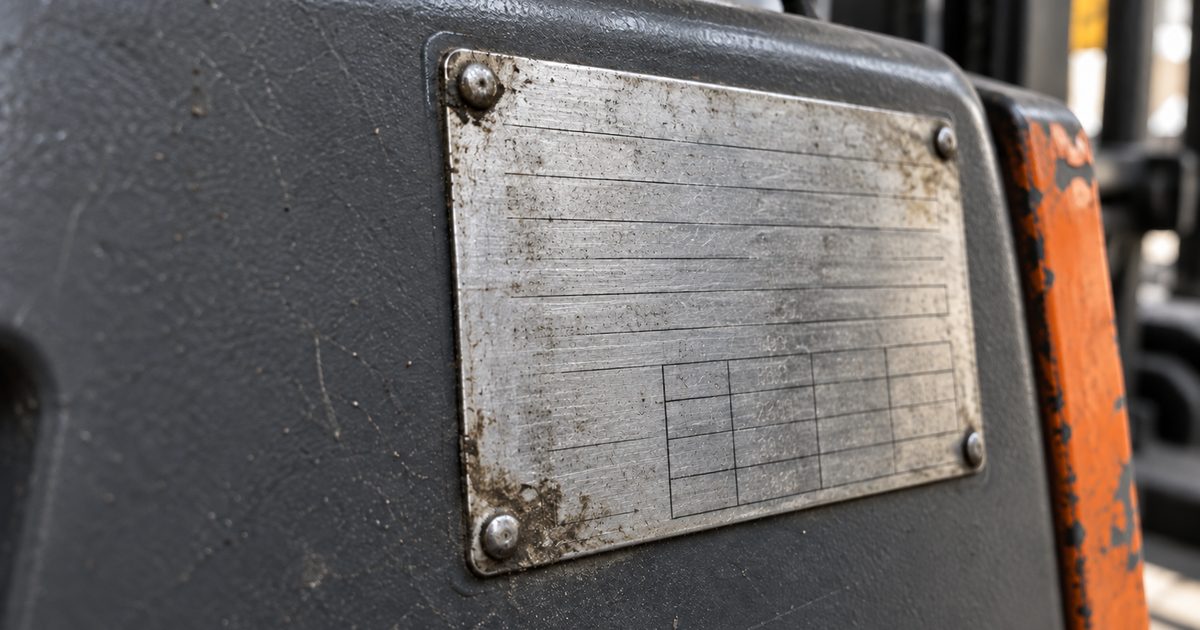
On almost every counterbalance truck built in the last thirty years the plate sits on the dash cowl in front of the driver, at eye level above the steering column. It carries what a model number never can: the serial, the rated capacity at a stated load centre, the fork height that rating applies to, the mast type, and a second de-rated line when an attachment is fitted.
If the machine sits in another country and all you hold is a phone, ask for these five photographs before anything else.
- The whole data plate, straight on, close enough to read every line.
- The serial stamped into the frame, next to the model number on the plate.
- The hour meter with the key turned on.
- The mast plate or mast stamp, which carries the mast type and the free lift.
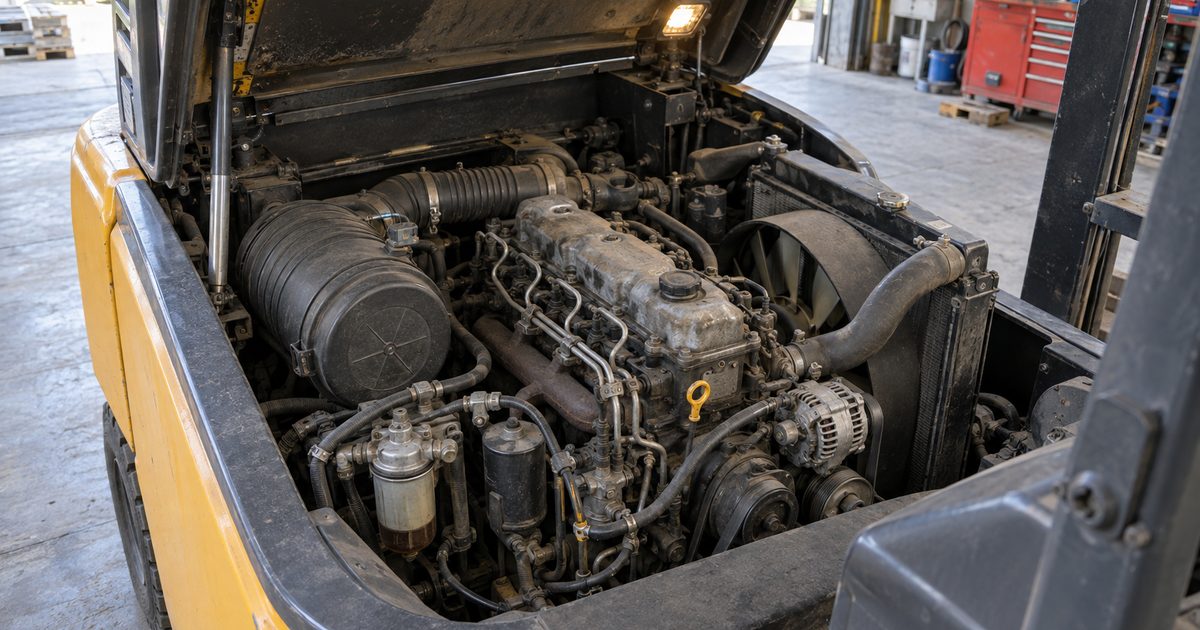
- The engine number stamped on the block.
Then ask three questions in writing. Which capacity line applies with the mast and attachment fitted now? What is the full model number, including any dash number, type number or series suffix, exactly as printed? And does the serial in the frame match the serial on the plate?
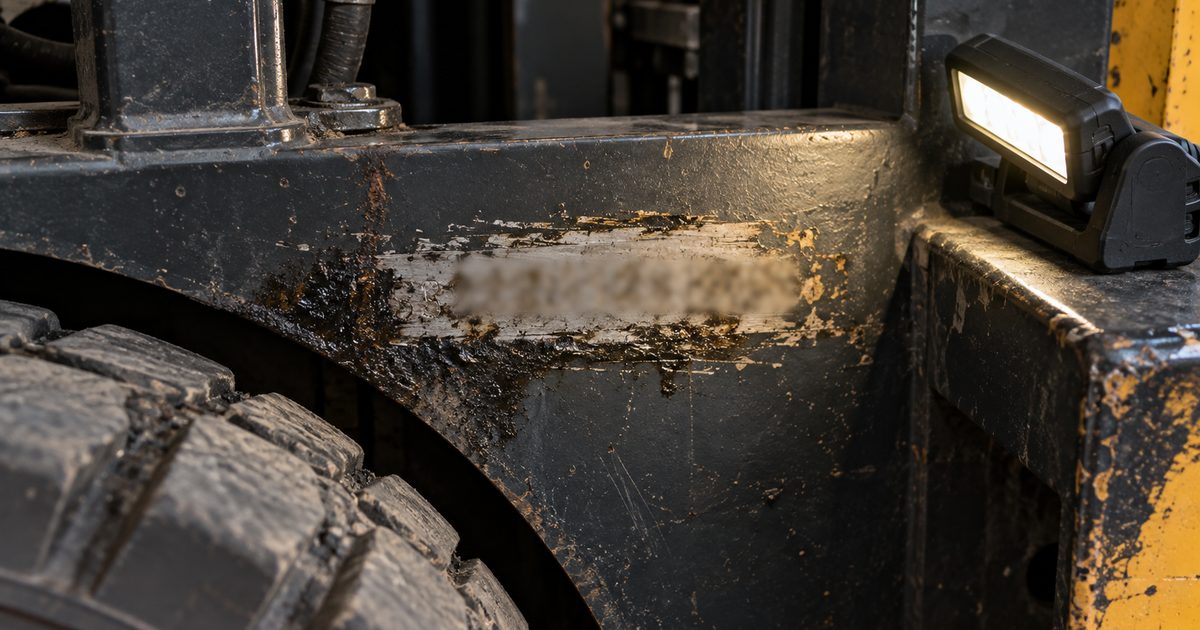
Straight answer. A clean badge on a truck whose plate is missing, painted over or riveted back on with fresh rivets is the most common warning sign on an export machine. A badge can be repainted in an afternoon. If the plate cannot be read, walk away or price it as a machine with no known rating.
That is also how we work. Tell us the capacity, the fuel, the mast height and the port it ships to, and we go and find the machine. Before you pay anything we send the plate photograph and the serial for that machine, so you can decode it against this page and run the year through our serial number year lookup. Our used forklift buying checklist covers the rest, and you can tell us what you are looking for.
Frequently asked questions
What does 8FD25 mean on a Toyota forklift?
It is an 8 Series Toyota forklift with a diesel engine and a nominal 2.5 tonne capacity. The 8 is the model series, the F is forklift, the D is diesel and the 25 is base capacity in tonnes with one decimal. Toyota's own guidance is to confirm the real rated capacity on the data plate, because it changes with mast height, tyres and attachments.
Does a forklift model number tell you the year?
No. Not on Toyota, Komatsu, Linde, Hyster, Yale or any of the Chinese brands. The model number gives you the type, the power source, the capacity and the design series. The year comes from the serial number, and on some brands from a letter inside it. See our serial number year lookup for the method brand by brand.
What does CPCD25 mean on a Heli or Hangcha forklift?
A counterbalance forklift with a counterweight body, a diesel engine and a hydraulic torque converter transmission, rated at 2,500 kg. CPQD in place of CPCD means petrol and CPD means battery electric. Chinese model numbers are rated at a 500 mm load centre, so confirm the plate before comparing one against a North American badge.
Why does the same forklift have two different model numbers?
Because Hyster and Yale badge the same truck differently for different markets. The metric badge gives capacity in tonnes and the North American badge gives it in hundreds of pounds, quoted at a different load centre. An H2.50XM and an H50XM are the same machine. Never convert one badge into the other, look up the pair.
What is the dash number on a Komatsu forklift, like -14 or -16?
It is the design series, meaning the generation of that model. A higher dash number is a newer design. It is not the year of manufacture, and two trucks badged FD25 in different series can take completely different parts, so always give a parts supplier the full model number including the dash.
The data plate is missing. Can the forklift still be identified?
Partly. The badge, the serial stamped in the frame and the engine number will usually get you to the family and often to the year, and a dealer can trace the rest from the serial. But a truck with no readable capacity plate has no established rating, and it should not be put to work until one is confirmed. Price it and treat it accordingly.

Written by The Forklifter team. We sell used and new forklifts across Pakistan and for export, and we rent across Pakistan. The advice here is the same we give buyers on WhatsApp before they spend a rupee or a dollar.