Most forklift makers buy their engines in, so the badge on the counterweight does not tell you what is under it. Here is who builds what, how to identify the engine in front of you, and where you will and will not find parts.
Why the engine matters more than the badge on the counterweight
Most forklift makers do not build their own engines. They buy them in, which means two trucks wearing the same badge and the same model number can have completely different engines under the counterweight. The badge tells you who built the truck. The engine tells you what it will cost to keep running.
That matters more than it sounds. The engine is the part you will buy filters, gaskets, injectors, a water pump and eventually a head gasket set for. If those parts sit on a shelf in your city, the machine is cheap to own. If every one of them has to come by sea from a single factory, the machine is cheap to buy and expensive to own. Same truck, two different lives.
Here is where to start looking. Fitment changes by year, by market and by spec, so treat this as a map rather than a guarantee and confirm it against the plate on the engine itself.
| Truck brand | Engine you commonly find | Who actually makes it |
|---|
| Toyota | 1DZ-II and later 1DZ-III diesel, 4Y petrol and LPG | Toyota, one of the few that builds its own |
| Komatsu | 4D92E, 4D94LE and 4D98E diesel, Nissan K21 or K25 on many LPG builds | Komatsu badged, cross referenced with Yanmar, plus Nissan |
| Mitsubishi and Caterpillar | S4S on 2 to 3.5 tonne trucks, S6S on the heavier ones | Mitsubishi |
| Heli | Isuzu C240 or 4JG2 on imported engine builds, 490 family on Chinese engine builds | Isuzu, or Xinchai and Quanchai |
| Hangcha | Xinchai 490 family or an Isuzu unit, depending on the build | Xinchai or Isuzu |
| Hyster and Yale | Bought in, and it varies by region and build year | Confirm on that model's own spec sheet |
This is the real reason one Chinese forklift is a good buy and another is not. A Heli CPCD25 with an Isuzu C240 in it and a CPCD25 with a Chinese unit are the same truck with two different ownership stories, and the gap between them on the invoice is usually smaller than the gap in what they cost to keep working. Our guide to Chinese forklift brands covers how that plays out over a few years.
Isuzu: the C240 and the 4JG2, the workhorses
The Isuzu C240 is the most widely fitted small forklift diesel there is. It is a four cylinder of about 2.4 litres, it has been in industrial use for decades, and it turns up under trucks from several different brands rated below roughly 3.5 tonnes. If the machine in front of you has one, your parts problem is mostly solved before you start.
The reason is what the C240 does not have. It is an indirect injection engine on a mechanical fuel pump. There is no common rail and no electronic injector control, and nothing on it needs a laptop. Any workshop that services small tractor and light truck diesels can work on it, and in most countries plenty of them already have. That is a very different proposition from a modern electronically managed engine in a place where nobody owns the diagnostic tool.
The 4JG2 is the bigger Isuzu you meet on heavier builds, four cylinders and about 3.1 litres. It also went into Isuzu road vehicles, which is the quiet advantage, because engines that were fitted to road vehicles leave parts behind in ordinary towns long after the machines they came in have gone. On some 5 tonne builds you will find a unit from the Isuzu 6BG1 family instead, so confirm which engine it is before you order a single part.
| Isuzu engine | Size | Typically fitted to | Why buyers want it |
|---|
| C240 | About 2.4 litres, four cylinder | Diesel trucks below about 3.5 tonnes, across many brands | Simple and mechanical, serviced almost anywhere |
| 4JG2 | About 3.1 litres, four cylinder | Heavier diesel builds, typically 3 to 3.5 tonnes | Shares parts with Isuzu road vehicles |
| 6BG1 family | Six cylinder | Some 5 tonne builds, confirm before you order | More engine for port and yard work |
Those capacity ranges are typical rather than fixed. The same model number was built with different engines for different markets, so the data plate on the truck and the plate on the engine are the only authorities worth trusting.
Yanmar, Nissan and Mitsubishi units, and where you find them
Yanmar, Nissan and Mitsubishi cover most of what Isuzu does not. Yanmar builds the small and mid size diesels and also supplies the design behind Komatsu's forklift engines. Nissan builds the petrol and LPG units you find in indoor and warehouse trucks, and Mitsubishi builds the diesels in its own lift trucks and in Caterpillar's.
Yanmar names its engines after the bore, which makes the code readable once you know the trick. A 4TNE92 is a four cylinder with a 92 millimetre bore and displaces about 2.7 litres. A 4TNE98 has a 98 millimetre bore and displaces about 3.3 litres. The model number stops being a code and starts being a size.
Nissan does the same thing in litres. The K21 is 2.1 litres and the K25 is 2.5 litres, both four cylinder petrol engines that run on LPG with the right kit. They are fitted well beyond Nissan's own trucks, and you will find a K21 or a K25 in Komatsu, TCM and some Caterpillar badged machines.
Mitsubishi's S4S is a four cylinder of about 3.3 litres used on 2 to 3.5 tonne diesel trucks from Mitsubishi, Caterpillar and Komatsu. The S6S is the six cylinder version at around 5 litres and it turns up in the heavier machines. Both have been built for a long time, and a long production run is exactly what creates a deep aftermarket.
| Engine | Maker | Size | Typically fitted to |
|---|
| 4TNE92 | Yanmar | About 2.7 litres, 92 mm bore | Smaller diesel trucks, roughly 1 to 2 tonnes |
| 4TNE98 | Yanmar | About 3.3 litres, 98 mm bore | Diesel trucks roughly 2 to 3.5 tonnes |
| K21 | Nissan | 2.1 litres, four cylinder | Petrol and LPG trucks, roughly 1.2 to 1.8 tonnes |
| K25 | Nissan | 2.5 litres, four cylinder | Petrol and LPG trucks a step up from the K21 |
| S4S | Mitsubishi | About 3.3 litres, four cylinder | Diesel trucks roughly 2 to 3.5 tonnes |
| S6S | Mitsubishi | Around 5 litres, six cylinder | Heavier diesel trucks |
Every capacity figure in that table is typical for the fitment, not a rule. Engine choice on the same model changed between markets and between build years, and that is why the plate on the engine beats any table, including this one.
Chinese engines: the 490, 495 and 498 families and who makes them
A 490, a 495 and a 498 are not three engines from one company. They are a size convention used by several different Chinese factories, and the number describes the engine rather than who built it. That is the most misunderstood thing about buying a Chinese forklift.
Read the number like this.
4Number of cylinders
95Cylinder bore in millimetres, so 95 mm
C490BPGThe letters around the number are the factory's own build code, here a Xinchai unit
The convention holds the whole way up the range, which is the best evidence you will get without a factory manual in front of you. Treat it as a convention rather than a stamped rule, and confirm the bore against the engine plate before you order parts on the strength of it.
| Forklift capacity | Engine family you usually find | What the number means |
|---|
| 1 to 1.5 tonnes | 485 | Four cylinders, 85 mm bore |
| 2 to 3.5 tonnes | 490, 495 and 498 | Four cylinders, 90 to 98 mm bore |
| 4 to 5 tonnes | 4105, with some 4 tonne builds on a 498 | Four cylinders, 105 mm bore |
| 5 to 10 tonnes | 6102, 6108 and 6110 | Six cylinders, 102 to 110 mm bore |
The names that actually matter are the factories, not the numbers. Xinchai, Quanchai, Xinjiang and Dachai build most of the 485 to 498 units, with Chaochai, Yuchai and Xichai appearing on the larger multi cylinder engines. The one you will meet most often is the Xinchai C490BPG, a common fit on the Heli CPCD25 and CPCD30 and on Hangcha trucks in the 2 to 3 tonne class.
Straight answer. A Chinese engine is not a bad engine. It is a cheaper engine with a shorter comfortable working life and a parts route that runs back to China. If a supplier near you stocks 490 family parts, it is a sensible buy. If nobody does, you are buying a machine that stops for weeks at a time, and no discount covers that. Ask the parts question before you ask the price question.
One more thing to settle before anything ships. A new engine sold into the European Union or the United States has to carry EU Stage V or EPA Tier 4 Final certification, and an engine built for the Chinese domestic market does not. The rules for used machines differ by country and by port, so get the position for your own port confirmed in writing rather than assuming it. Our Chinese forklift brands guide covers the rest of the import side.
How to find out which engine is in a machine before you buy it
Read the plate on the engine, not the brochure and not the model number on the counterweight. Ask the seller for one clear photograph of the engine data plate, or of the number stamped into the block, and you have your answer in a minute from anywhere in the world.
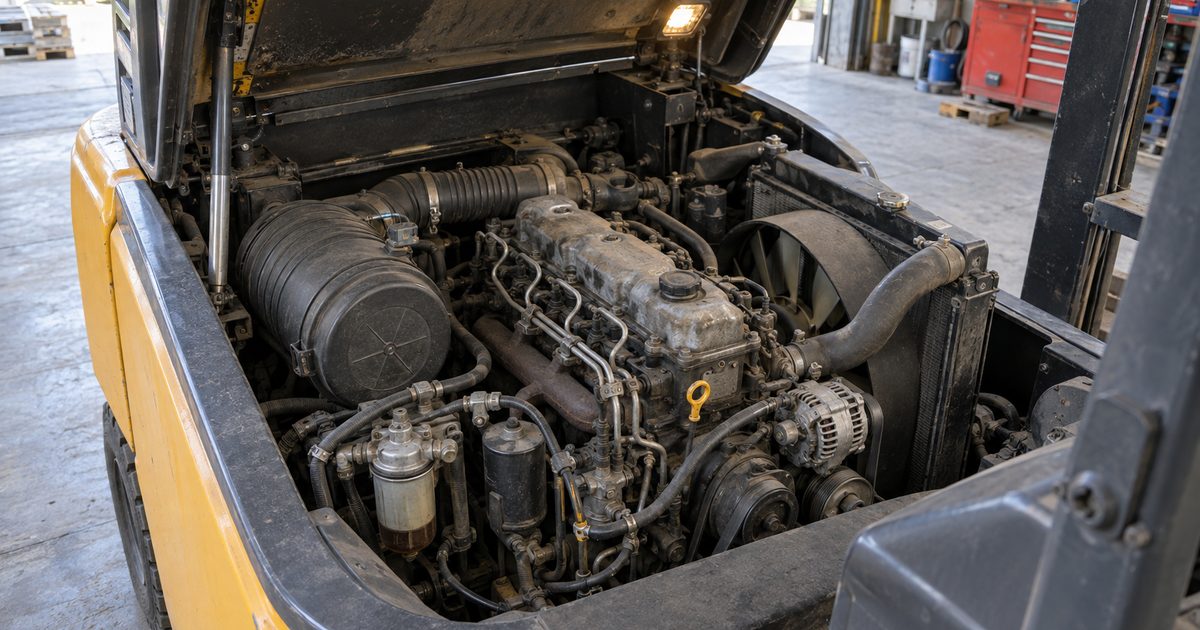
On a counterbalance truck the engine sits under the seat, and the whole seat deck lifts to get at it. The plate is usually on the rocker cover or on a flat face of the block. Where the plate has gone, the number is stamped into the block itself, commonly near the injection pump. It is a two minute job for anyone standing next to the machine, so a seller who will not do it is telling you something useful.
Ask for these photographs and one video before you send any money.
- The engine plate, or the stamped number on the block, close enough to read every character.
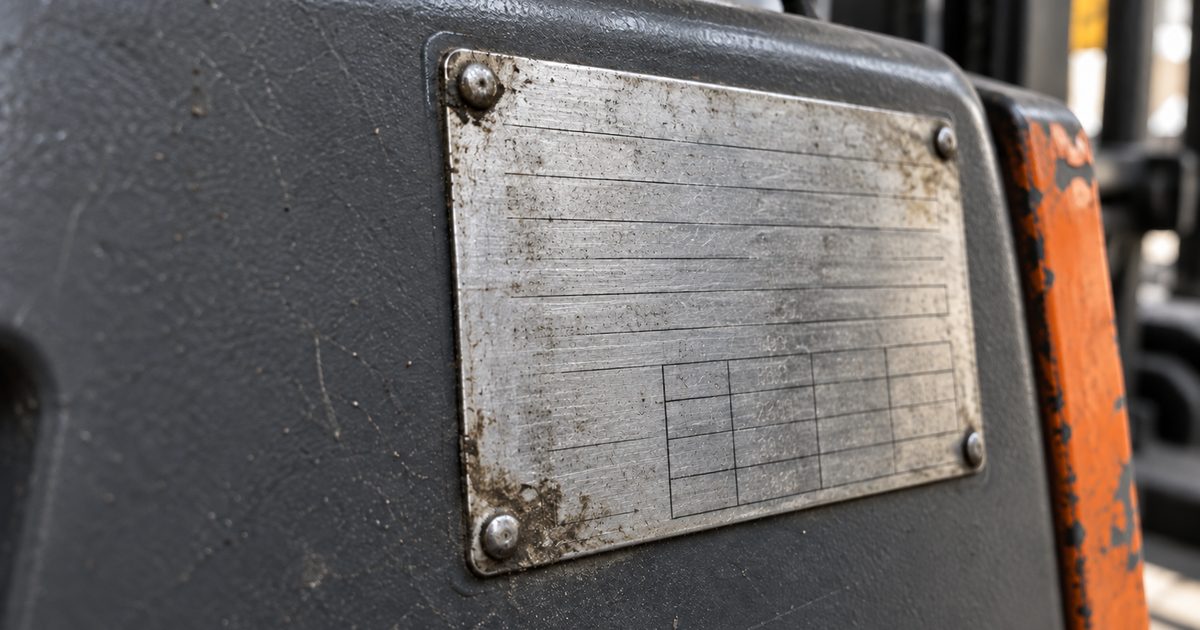
- The truck data plate, showing the model, the serial, the rated capacity and the load centre.
- The hour meter, photographed with the key turned on.
- The engine bay from above, so you can see leaks, hoses, wiring and how the machine has been looked after.
- The exhaust outlet and the paintwork around it.
- A video of a cold start, from key on to steady idle, with the sound on.
The cold start is the one that earns its place. White smoke that clears as the engine warms is usually just cold running. Blue smoke that keeps going is oil getting somewhere it should not. Heavy black smoke under load points at fuel or air. None of that is a diagnosis on its own and none of it replaces a mechanic, but it tells you and your mechanic where to look before anybody books a flight. Our used forklift buying checklist covers the rest of the machine, and the forklift model number decoder covers the code on the counterweight.
Which engines are easy to keep running, anywhere in the world
The engines that are easy to live with are the ones that also went into road vehicles, tractors or generators, because that is what puts parts in ordinary towns. An Isuzu C240 or a Nissan K25 can be sorted in most countries by a workshop that has never touched a forklift. An engine built only for the Chinese domestic market usually cannot.
| Engine | Where the parts realistically come from | What that does to your downtime |
|---|
| Isuzu C240 and 4JG2 | Independent diesel workshops and parts stores in most countries | Usually days |
| Nissan K21 and K25 | Petrol and LPG parts suppliers, very widely stocked | Usually days |
| Yanmar 4TNE and Komatsu 4D9 family | Yanmar and Komatsu dealers plus a large cross referenced aftermarket | Days to a couple of weeks |
| Mitsubishi S4S and S6S | Mitsubishi and Caterpillar lift truck dealers plus a strong aftermarket | Days to a couple of weeks |
| Chinese 490, 495 and 498 | Chinese parts specialists near you, or direct from China by sea | Days if held locally, otherwise weeks |
Those lead times are what we see in practice as at August 2026, and they depend entirely on your country and your port, so confirm them with whoever will actually support the machine. A dealer pin on a map is not the same thing as a person with a van and a shelf of gaskets.
There is one cross reference worth knowing about. Komatsu's forklift diesels, the 4D92E, the 4D94LE and the 4D98E, share their design with the Yanmar 4TNE family, and parts catalogues and rebuild kits are routinely sold covering both numbers together. That widens the parts net a long way, and it is part of why a Komatsu is straightforward to keep running well away from a main dealer.
Before you commit to any machine, make one phone call. Ring the nearest diesel workshop or parts store to where the forklift will actually work, read them the engine number off the photograph, and ask two questions. Have you worked on one of these, and can you get me a head gasket set. The answer is worth more than any brochure and it costs you five minutes.
When you tell us what you need, give us the engine as well as the capacity. We treat it as part of the spec, and the photograph of the engine plate on the actual machine comes to you before you commit to anything. Tell us what you are looking for and we go and find it.
Frequently asked questions
What engine is in my forklift?
Read the plate on the engine itself, or the number stamped into the block, usually reached by lifting the seat deck. The model number on the counterweight tells you about the truck and rarely tells you the engine, because most makers fitted different engines to the same model in different markets and build years.
Which forklift engines are easiest to get parts for?
The ones that were also used outside forklifts. The Isuzu C240 and 4JG2, and the Nissan K21 and K25, are supported by ordinary diesel and petrol workshops in most countries. Yanmar, Komatsu and Mitsubishi units are well served too. An engine built for the Chinese domestic market depends entirely on whether a supplier near you stocks it.
Are Chinese forklift engines any good?
They do the job, they are cheap to buy and they are cheap to repair where parts are held. They have a shorter comfortable working life than a Japanese unit and the parts route runs back to China, so the honest test is not the engine itself, it is whether anybody near you holds parts for it.
Is the Komatsu 4D92E the same as a Yanmar 4TNE92?
They share their design, and parts catalogues and rebuild kits are commonly sold covering both numbers together. Treat that cross reference as a strong lead when you are hunting parts, then confirm the exact part against your own engine's number before you buy it.
Does Toyota build its own forklift engines?
Yes, which is unusual in this industry. The 4Y petrol and LPG engine and the 1DZ-II and later 1DZ-III diesels are Toyota units. That is one of the reasons a Toyota holds its value, though it also ties you to the Toyota parts network more than a bought in Isuzu would.
How do I check the engine on a machine in another country?
Ask for photographs of the engine plate, the truck data plate and the hour meter, plus a video of a cold start with the sound on. That set costs the seller a few minutes and tells you what you are buying. A seller who will not send it is answering your question a different way.

Written by The Forklifter team. We sell used and new forklifts across Pakistan and for export, and we rent across Pakistan. The advice here is the same we give buyers on WhatsApp before they spend a rupee or a dollar.