The year is printed on the plate on some machines and buried in the serial number on others. Here is where to look brand by brand, the Hyster and Yale year letter table, and the photos to ask a seller for before you pay.
Where the serial number and data plate are on a forklift
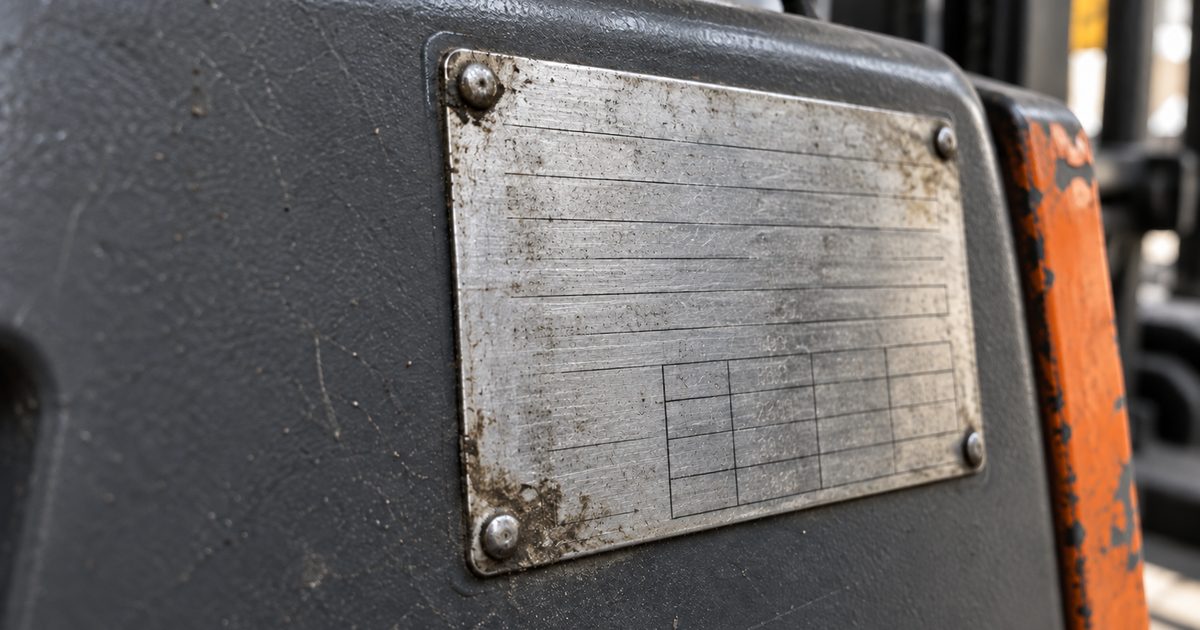
The serial number sits in two places on almost every forklift. It is printed on the data plate, a metal tag riveted to the truck, and it is stamped into the steel of the chassis. The plate is the easy one to read. The frame stamp is the one that cannot be unbolted and swapped, so it is the one worth finding.
The plate is usually on the dash cowl in front of the driver, on the pillar beside the seat, or on the side of the frame. It carries the maker, the model, the serial, the unladen weight and the rated capacity at a stated load centre. On many machines it carries the build year outright, so read every line before you decode anything.
Two numbers get mixed up constantly. The mast has its own serial plate and often its own build date, and that is not the truck serial. A mast can be changed. So when you write a serial down, write down where you read it.
| Brand | Data plate, commonly | Serial also stamped on |
|---|
| Toyota | Dash cowl or the pillar by the seat | The chassis frame, commonly at the front near the mast |
| Hyster and Yale | Cowl or console, or the pillar behind the seat | The frame in the footwell, or behind the front tyre |
| Komatsu | Near the seat | The chassis |
| Crown | Near the controls on the dash, or the frame by the counterweight | The mast, often with a build date beside it |
| Caterpillar and Mitsubishi | Nameplate near the dash | The chassis just above the front wheel on the right |
| Clark | Nameplate near the dash | The left side of the chassis frame |
| Heli, Hangcha and EP | Nameplate by the dash or the seat | Varies by model, ask for a photo of the frame around the mast |
Positions move between models and years, so treat that as where to look first, not a promise. Once you can read the plate, our forklift model number decoder explains what the model's letters and digits mean.
Why the serial, not the model number, gives you the year
A model number tells you what the machine is. It does not tell you when it was built. A Toyota 8FD25 has been on sale for the best part of twenty years, so the model puts a truck in an era, not a year. The serial is the only number tied to a production run and a date.
The series digit brackets it, and that is all it does. The Toyota 8 series has been in production since the mid 2000s and is still sold, so an 8FD25 could be nearly twenty years old or nearly new. Komatsu uses a dash number for the same job, Linde a three digit type number. Those change every few years, not every year.
Buyers ask what year is my forklift for practical reasons, not curiosity. Parts books are split by serial break rather than by model, which is why the parts desk asks for the serial. Insurers, finance houses and auctions will not take a guess at a year of manufacture. And some countries cap the age of imported used machinery, a rule set by your own customs authority, so check yours first.
Worth saying out loud. The year is not the number that decides the deal. A gently used machine from 2012 will outlast a hammered one from 2019. Get the year confirmed for the paperwork, then judge the truck on
the hours on the meter and its condition.
Toyota serial numbers and year
Toyota does not put the year in the serial number. Toyota uses a combined system where the serial carries model information and then a sequential build number, so turning it into a year means matching that build number against the production ranges for that exact model.
Toyota's own guidance is to work from the data plate and treat the two numbers as one item. Toyota says the serial is the most important number on the lift, and that the model and serial combination is what identifies your particular machine. No Toyota letter or digit means a year, on any series.
So the method is short. Read the model and serial off the plate, photograph the frame stamp, and check the two match. Send both to a Toyota dealer and ask for the year of manufacture in writing. A dealer does that from the serial in a few minutes.
Serial range charts published by parts sellers are useful and cover most common models. Just know what they are. They are transcriptions of Toyota data, not Toyota documents, and they stop at the models that seller stocks. Where a chart and a dealer disagree, take the dealer.
Hyster and Yale: the last letter, the skipped letters, and the 23 year trap
On a Hyster or a Yale the last letter of the serial number is the year code. The letters run from A, but I, O and Q are skipped so they cannot be misread as numbers, which leaves 23 usable letters. That is the catch. The same letter comes back around every 23 years, so the letter only gives you a year once you already know roughly the decade.
Hyster and Yale belong to the same company and share the serial system. On a modern truck it has four parts. Take H177V03230X, a made up serial we are using to show the shape.
| Part | In H177V03230X | What it tells you |
|---|
| 1 | R177 | Four characters for the design series and the model |
| 2 | V | One letter for the plant that built it |
| 3 | 03230 | The production sequence, which starts at 1501 rather than at 1 |
| 4 | X | One letter for the year, so 2023 on a machine of this age |
Here is the full cycle. Find the last letter of your serial, then read across to the column that matches the machine in front of you.
| Last letter | 1957 to 1979 | 1980 to 2002 | 2003 to 2025 |
|---|
| A | 1957 | 1980 | 2003 |
| B | 1958 | 1981 | 2004 |
| C | 1959 | 1982 | 2005 |
| D | 1960 | 1983 | 2006 |
| E | 1961 | 1984 | 2007 |
| F | 1962 | 1985 | 2008 |
| G | 1963 | 1986 | 2009 |
| H | 1964 | 1987 | 2010 |
| J | 1965 | 1988 | 2011 |
| K | 1966 | 1989 | 2012 |
| L | 1967 | 1990 | 2013 |
| M | 1968 | 1991 | 2014 |
| N | 1969 | 1992 | 2015 |
| P | 1970 | 1993 | 2016 |
| R | 1971 | 1994 | 2017 |
| S | 1972 | 1995 | 2018 |
| T | 1973 | 1996 | 2019 |
| U | 1974 | 1997 | 2020 |
| V | 1975 | 1998 | 2021 |
| W | 1976 | 1999 | 2022 |
| X | 1977 | 2000 | 2023 |
| Y | 1978 | 2001 | 2024 |
| Z | 1979 | 2002 | 2025 |
The cycle starts again with A in 2026. I, O and Q never appear, so if you think you are reading one of them, you are reading a 1, a 0, or a letter that has worn.
The trap the other pages leave out. An X is 2023. It is also 2000, and it is also 1977. The letter is worth nothing without the decade. Date the machine roughly from what you can see, the style of the dash and mast, the tyres, the emissions decal, then let the letter give you the exact year inside that decade.
That cycle is what Hyster and Yale dealers and the main parts references publish, and it lined up across every source we checked. Trucks older than the four part format can be numbered differently, so on anything that looks pre 1990s, confirm with a dealer using the whole serial.
Komatsu, Linde, Heli, Hangcha and Crown
Outside Hyster and Yale, most makers give you no year code you can read off the serial with confidence. On many machines the year is simply printed on the plate. On the rest, the maker's own records are the only thing that settles it. So read the whole plate first, and only then start asking.
One rule helps more than any decoder. A machine built to be sold in Europe or the United Kingdom must carry, in its marking, the maker's name and address, the designation of the machine, the CE or UKCA mark, the series or type, the serial number if there is one, and the year of construction. That is the EU Machinery Directive 2006/42/EC and the matching British regulation, where year of construction means the year manufacturing was completed. So on a CE marked forklift the year should already be on the plate. If it is not, ask why.
Komatsu
The plate is commonly near the seat and the serial is also stamped on the chassis. Year letter tables for Komatsu forklifts circulate online, and the ones we compared contradict each other, so we are not printing one. The dash number in a model like FG25T-11 gives the generation, not the year. Send the full serial to a Komatsu dealer.
Linde
Linde uses a three digit type number for the series, such as 391, 392 or 394, and the year is generally shown by a letter sitting after it in the serial. The two published Linde year tables we compared disagree, both by a year and on whether the letter I is used at all, so neither is printed here as fact. Go to the plate instead. Most Linde trucks were built for Europe, so the year of construction should be on it.
Heli, Hangcha and EP
We could find no public year decoder for the Chinese brands that survives checking, and inventing one would be worse than saying so. What works is simpler. Many Chinese nameplates print the build date outright, so look there first. If the plate is gone, the factory can date the truck from the serial, and a serious seller will get it.
Crown
Crown publishes no year decoder either. On Crown machines the build date is commonly stamped into the mast, near the mast serial on its upper part, so look there first. Crown can also date a truck from the serial.
Caterpillar and Mitsubishi
These lift trucks commonly print the year on the capacity plate, so there is nothing to decode. If the plate has gone, the serial is commonly stamped on the chassis just above the front wheel on the right.
| Brand | Year readable from the serial? | What actually works |
|---|
| Toyota | No | Model plus serial against the production ranges, or a Toyota dealer |
| Hyster | Yes, the last letter | Read the letter, then fix the decade from the machine |
| Yale | Yes, the last letter | Same system and same table as Hyster |
| Komatsu | Not reliably, in public sources | Full serial to a Komatsu dealer |
| Linde | A letter follows the type number, but published tables disagree | Year of construction on the plate, or confirm with Linde |
| Crown | Not published | Build date commonly stamped on the mast, or ask Crown |
| Caterpillar and Mitsubishi | Year commonly printed on the plate | Read the plate |
| Heli, Hangcha and EP | No public decoder we could verify | Build date often on the plate, otherwise the factory through the seller |
| Any CE or UKCA marked machine | Year of construction required in the marking | Read the plate |
Every row there is a starting point, not a guarantee. Confirm the year with the maker or a franchised dealer before it goes on an invoice.
When the plate is missing, painted over or replaced
A missing or painted over data plate is a finding in itself. The American workplace rule puts it plainly: the user shall see that all nameplates and markings are in place and are maintained in a legible condition. A truck with no plate has a story, and you want it before you pay.
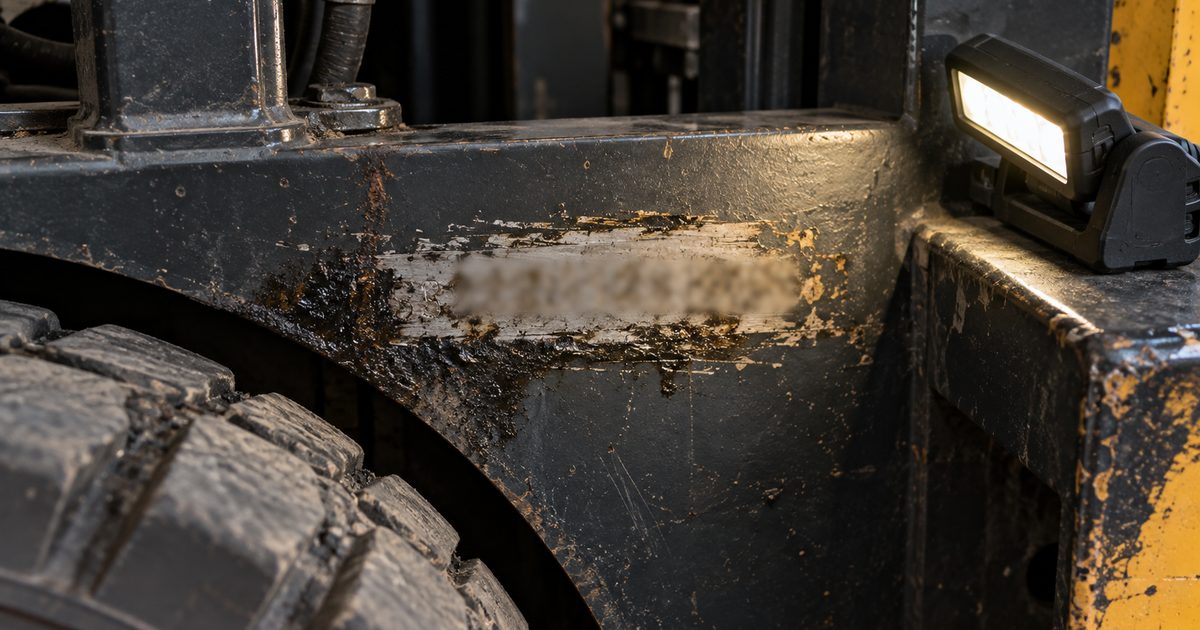
Start with the frame stamp, because paint hides a stamp but does not remove it. Wipe the area with a degreaser, then shine a light across the steel at a low angle so the characters throw a shadow. If fingers can feel the numbers but the camera cannot, lay paper over the stamp and rub a pencil flat across it. The number lifts onto the paper and photographs cleanly, which matters at a distance.
Then collect the other dates on the machine. The mast carries its own number and often its own build date, and the engine has its own serial. On an electric truck the traction battery plate carries a build date, though a battery is the part most likely to have been swapped, so it dates the battery rather than the truck.
Treat the plate itself as evidence. Overspray across it, bright new rivets on an old machine, or a capacity figure that does not match the mast and attachment fitted are all worth a question. The same rule says that where modifications affect capacity, the plates must be changed accordingly, so a plate describing a different machine is a real problem.
Most makers supply a replacement plate against the serial, so ask what that costs and how long it takes. If nobody can produce a serial at all, price the machine as one with no history, because that is what it is. Our guide to buying a forklift from overseas covers what else that changes.
What to ask a seller to photograph before you pay anything
You are probably reading this because the machine is in another country and you cannot walk up to it. So do not ask the seller for the year. Ask for the photographs that prove it, and read them yourself. A straight seller sends the lot the same day.
Ask for these seven as one set, before any money moves.
- The whole data plate, square on and close enough to read every line, with no flash glare.
- The serial stamped into the frame, with a thumb or a coin beside it so you can judge the scale.
- The hour meter, with the key on.
- The mast plate or the mast stamp, which is where a Crown build date lives.
- The engine number, or on an electric truck the battery plate.
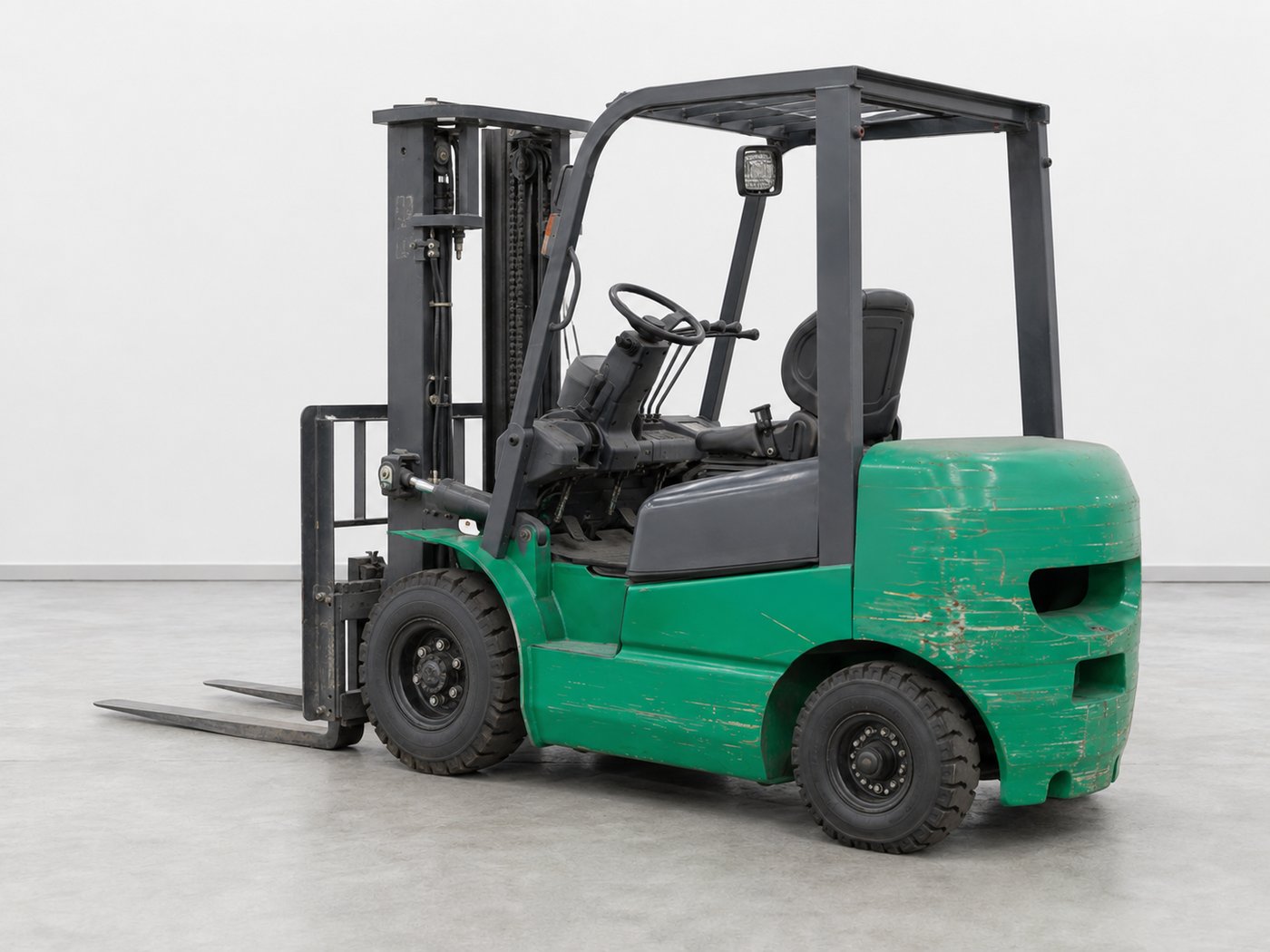
- A wide shot of the machine from both sides, so the close ups can be tied to this truck.
- One unbroken video walking from the plate, to the meter, to the machine starting and lifting.
Then put three questions in writing. Does the serial on the plate match the serial stamped on the frame. Is a year printed anywhere on the plate. Will you put the model, serial, year and hours on the invoice. A seller who answers all three has nothing to hide, and one who will not answer the first has told you something useful anyway.
While you wait for the photos, run the machine through our used forklift buying checklist, because a confirmed year is only one line of a good purchase.
How we work. We are a sourcing dealer, not a yard full of machines. You tell us the brand, capacity and fuel you need and your nearest port, and we go and find the machine. We read the plate and the frame stamp ourselves, send you both photographs, and put the model, serial, year and hours on your paperwork.
Tell us what you are looking for and we will start.
Frequently asked questions
How do I find out what year my forklift is?
Read the data plate first, because plenty of plates print the build year outright. If yours does not, the serial number is the route. On a Hyster or a Yale the last letter of the serial is the year. On most other makes you send the full serial to the maker or a franchised dealer and they date it from their records.
Can you tell a forklift's year from the model number?
No. The model number gives you the type, the fuel and the capacity, and the series digit only brackets an era. The Toyota 8 series has been built since the mid 2000s and is still sold, so the model alone can be out by nearly twenty years.
What year is a Hyster forklift with a serial ending in X?
2023, or 2000, or 1977. Hyster and Yale year letters skip I, O and Q, which leaves 23 letters, so the same letter repeats every 23 years. You have to fix the decade from the machine itself before the letter means anything.
Where is the serial number on a forklift?
In two places. Printed on the data plate, usually on the dash cowl, the pillar by the seat or the side of the frame, and stamped into the chassis. Check that the two match, because a plate can be swapped and a frame stamp cannot.
What do I do if the forklift has no data plate?
Look for the frame stamp under the paint, and use the mast number, the engine number and the battery plate as second dates. A missing plate is also a bargaining point and a reason to ask more questions, since owners are required to keep nameplates in place and legible.
Does the year matter more than the hours?
No. Hours and condition decide how much working life is left. The year matters for parts books, insurance, finance and import age rules, so you still want it confirmed in writing on the invoice.

Written by The Forklifter team. We sell used and new forklifts across Pakistan and for export, and we rent across Pakistan. The advice here is the same we give buyers on WhatsApp before they spend a rupee or a dollar.