Logistics
How to ship a forklift in a container: fit, weight and lashing
Container or RoRo, will it fit, how many go in a 40ft, what it weighs and how it is lashed down. The physical side of moving a forklift, with the numbers.
27 August 2026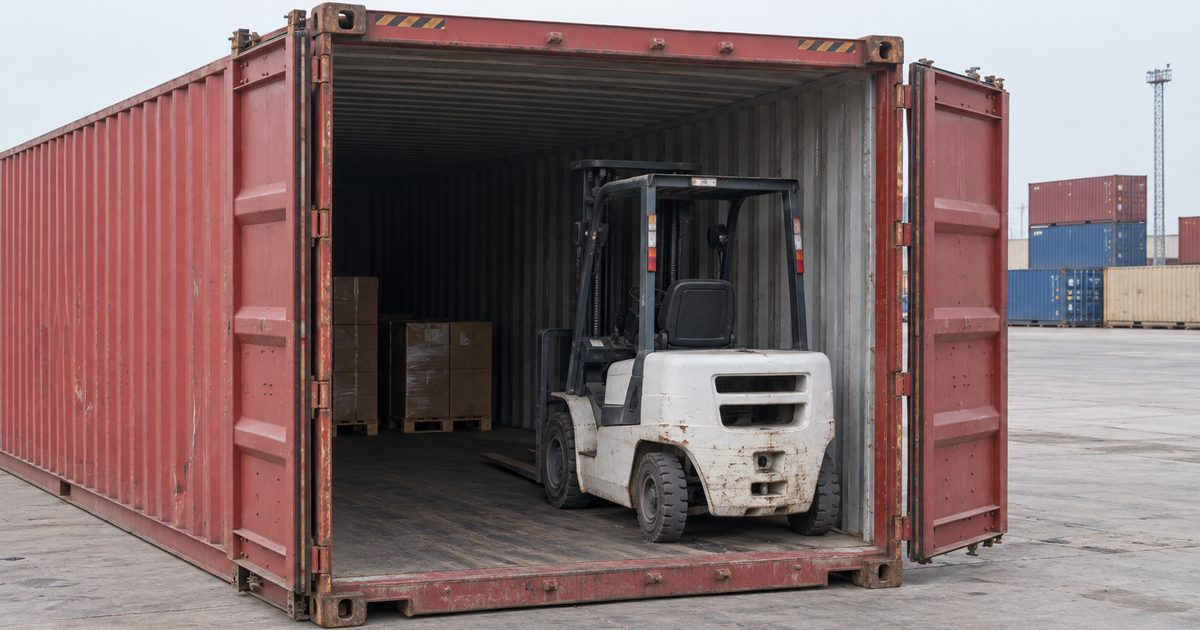
A container spec forklift lives or dies on two numbers, collapsed mast height and free lift. Here are the real figures from manufacturer data sheets, and what to send us so we can find one that fits.
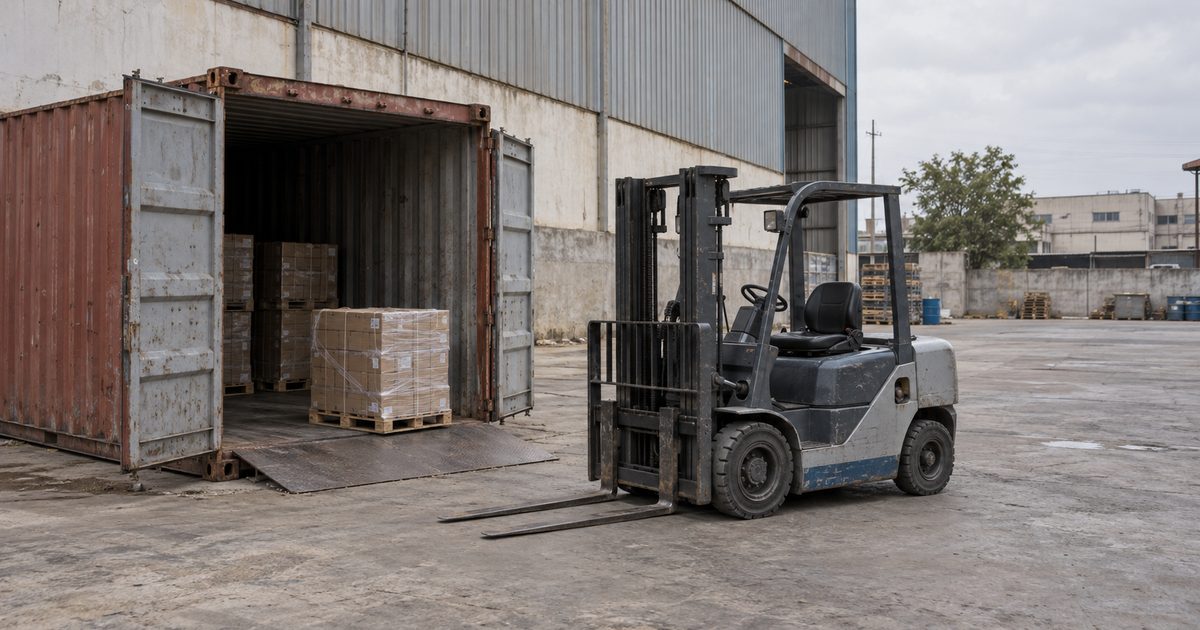
The door opening decides what a container spec forklift has to be, not the space inside the box. On a standard 20ft or 40ft dry container that opening is about 2,340 mm wide and about 2,280 mm high. The inside of the box is taller than its own doorway, about 2,390 mm, so a machine that would fit in there can still be too tall to get through the door.
The reason is the frame. A container is a steel box with a header beam across the top of the door and a sill across the bottom, and both eat into the opening. That is why the number you buy a machine on is the door opening, never the internal height.
Three parts of the truck have to pass under that header. The mast with the forks on the ground, the overhead guard above the driver, and anything bolted to the fork carriage such as a load backrest or a clamp. Once a low mast is fitted, the overhead guard is often the tallest part of the machine, and that is the part most buying guides never mention.
If what you need is the working method inside the box rather than the spec of the machine, our guide on how to unload a shipping container with a forklift covers the sequence and the safety points.
A 20ft and a 40ft standard dry container share the same cross section. Both are roughly 2,350 mm wide and 2,390 mm high inside, with a door opening of about 2,340 mm by 2,280 mm. Only the length changes. The 40ft high cube is the exception, roughly 300 mm taller both inside and at the door.
| Container | Internal length | Internal width | Internal height | Door width | Door height |
|---|---|---|---|---|---|
| 20ft standard dry | about 5,900 mm | about 2,350 mm | about 2,390 mm | about 2,340 mm | about 2,280 mm |
| 40ft standard dry | about 12,030 mm | about 2,350 mm | about 2,390 mm | about 2,340 mm | about 2,280 mm |
| 40ft high cube | about 12,030 mm | about 2,350 mm | about 2,690 mm | about 2,340 mm | about 2,585 mm |
Every figure above is typical, and typical is the honest word. Published numbers for the same box do not agree. Most carriers and forwarders quote 2,280 mm at the door of a standard dry container, several container sellers quote 2,260 mm, and one widely read reference gives an average of about 2,261 mm. Internal height is quoted anywhere from 2,350 mm to 2,395 mm. Containers are built by many factories over many decades, so the spread is real rather than sloppy.
The working rule that comes out of it is simple. Design for the smallest opening you might meet, not for the average. That is where the 2.2 m target in the next section comes from.
Width is rarely what stops you. A 2.5 tonne counterbalance truck is around 1,180 mm across the tyres, so in a 2,340 mm doorway you have roughly 580 mm each side. That feels generous at the door and a lot less generous when you are reversing 12 m down a 40ft box in a straight line with a load in front of you.
The high cube is worth knowing about and not worth planning around. If your work is mostly export boxes, assume standard dry, because standard dry is what turns up.
Collapsed mast height is the height of the mast with the forks on the floor. On a European spec sheet it is listed as h1, under VDI 2198. Aim for 2,200 mm or lower rather than 2,280 mm, because that spare 80 mm is your margin for the door sill, the ramp angle as the truck crosses it, a settled or uneven dock, and the differences between boxes.
Here is why this matters more than it sounds. The mast a manufacturer fits as standard on a 2.5 tonne truck is usually too tall for a container door by a few millimetres. Linde publishes 2,288 mm as the lowered mast height of a standard H25 D and 2,275 mm for the overhead guard above the driver. Against a 2,280 mm door opening, that machine does not go in.
Manufacturers know it, which is why a container spec forklift is a factory option and not a workshop bodge. Linde lists an H35 D Container in the same data sheet, a 3.5 tonne truck with the lowered mast cut to 2,230 mm and the overhead guard cut to 2,222 mm. What you pay for it is lift height. The container build tops out at 3,095 mm instead of 3,295 mm.
| Measurement (VDI 2198) | Linde H25 D, standard build | Linde H35 D, standard build | Linde H35 D Container |
|---|---|---|---|
| Rated capacity at 500 mm load centre | 2,500 kg | 3,500 kg | 3,500 kg |
| Mast lowered, h1 | 2,288 mm | 2,330 mm | 2,230 mm |
| Overhead guard, h6 | 2,275 mm | 2,322 mm | 2,222 mm |
| Lift height, h3 | 3,230 mm | 3,295 mm | 3,095 mm |
| Overall width, b1 | 1,180 mm | 1,256 mm | 1,256 mm |
| Service weight | 3,918 kg | 4,978 kg | 4,950 kg |
| Front axle load, laden | 5,560 kg | 7,487 kg | 7,458 kg |
Those figures are transcribed from the published Linde data sheet for the H20 to H35 range. They are typical of the class rather than true of every build. The useful part is that every maker quotes the same measurements under the same VDI numbers, so once you hold two spec sheets you can compare any two machines line for line. Confirm the exact figures for the machine in front of you on its own spec sheet and data plate.
Free lift is how far the forks rise before the mast itself starts to get taller. A standard mast gives about 150 mm, which is enough to pick a pallet off the ground and nothing more. A full free lift mast gives around 1,500 mm, and that is what lets you raise and place a load inside a box where there is barely a hand's width above the mast.
Without free lift the machine is close to useless in there. You drive in, you lift, the mast grows, and it meets the container roof long before the load is high enough to stack. The lift height printed on the spec sheet counts for nothing inside the box. Free lift is the only lift you get.
| Mast type | Lift height h3 | Lowered height h1 | Free lift h2 | Extended height h4 |
|---|---|---|---|---|
| Standard two stage | 3,150 mm | 2,121 mm | 150 mm | 3,753 mm |
| Standard two stage | 3,850 mm | 2,471 mm | 150 mm | 4,453 mm |
| Duplex, full free lift | 3,145 mm | 2,121 mm | 1,518 mm | 3,747 mm |
| Duplex, full free lift | 3,845 mm | 2,471 mm | 1,868 mm | 4,447 mm |
| Triplex, full free lift | 4,625 mm | 2,121 mm | 1,519 mm | 5,227 mm |
| Triplex, full free lift | 5,475 mm | 2,471 mm | 1,869 mm | 6,077 mm |
That is the mast list published for one machine family, the Linde H16 to H20 range, so the rows compare directly. Read it across and the point makes itself. At the same 2,121 mm lowered height you can have 150 mm of free lift or 1,519 mm. The triplex carries that free lift and 4,625 mm of lift height together, so the machine still serves your racking when it is not in a container. Go up one mast size and the lowered height jumps to 2,471 mm, which will not pass a container door at all.
How much free lift you need is set by your load and not by a rule of thumb. Measure your loaded pallet at its tallest, add roughly 100 mm of clearance, and that is your minimum free lift if you want to put a second pallet on top of the first inside the box.
The triplex is not free. Three sets of rails mean more rollers, more chain and more hydraulic hose to wear out, and the view through the mast is busier than a two stage. If you never stack above one pallet inside the container and never need height outside it, a full free lift duplex does the job with less to go wrong.
The tonnage cast into the counterweight is a rating at one load centre, normally 500 mm. Push the weight further out on the forks and the safe capacity falls quickly. Linde rates the H25 at 2,500 kg with a 500 mm load centre, 2,250 kg at 600 mm and 2,050 kg at 700 mm. Nothing about the machine changed except where the load sits.
| Load centre | Capacity up to about 5,500 mm lift | Capacity at 6,800 mm lift |
|---|---|---|
| 400 to 500 mm | 2,500 kg | 1,500 kg |
| 600 mm | 2,250 kg | 1,350 kg |
| 700 mm | 2,050 kg | 1,230 kg |
| 800 mm | 1,880 kg | 1,130 kg |
Those are published figures for one 2.5 tonne machine with its standard mast and fork carriage, and they are typical rather than universal. The capacity plate on the machine you buy is the authority, because it is rated for the mast and carriage actually fitted.
Height derates it again. The same truck that carries 2,500 kg up to about 5,500 mm is down to 1,500 kg by 6,800 mm. You never lift high inside a container, so height is rarely the problem in there. It becomes the problem the moment that machine goes back to the racking, so specify both jobs together.
Attachments take their own bite. A clamp, a rotator or a fork positioner adds weight ahead of the front axle and pushes the load further out, so the truck has to be rated again with it fitted. If a seller shows you a machine wearing a clamp and a capacity plate that says nothing about that clamp, that is the question to ask before anything else.
Then there is the floor. A laden forklift is heavier than people expect and nearly all of it lands on two front wheels with small solid tyres. Linde publishes a laden front axle load of 5,560 kg for the H25 D and 7,458 kg for the H35 D Container. That is what the container floor takes, concentrated into two small contact patches, and moving.
Weight matters on the way to you as well, because the machine itself has to travel. What fits, what it weighs and how it is secured is covered in our guide to shipping a forklift in a container.
Send us six things and we can go and look for the right container spec forklift instead of guessing. The container type you work, your heaviest load and its load centre, the height of a loaded pallet, whether you stack two high inside the box, the lift height you need outside the container, and your port.
What comes back is the spec sheet for that actual machine with h1, h2 and h3 on it, photographs of the data plate and the hour meter, and the capacity plate as fitted with any attachment on the carriage. Those papers let you check every claim on this page against the machine you are offered.
For heavier work in the yard around the container rather than inside it, our Hyster buying guide covers the big capacity end. Every maker sells much the same mast families under its own names, and a model number gives you the capacity but never the mast, which is why our Toyota guide ends where this one does: ask for the spec sheet. When you know your numbers, tell us what to find.
It is a counterbalance forklift built to work through a container door. In practice that means a mast that folds down to about 2,200 mm or lower, a full free lift mast so the forks rise inside the box without the mast getting taller, and often a lower overhead guard. Some makers sell it as a listed factory model, such as the Linde H35 D Container.
The door opening on a standard dry container is about 2,280 mm high, so the lowered mast, the overhead guard and anything on the fork carriage all have to pass under that. Aim for 2,200 mm or lower to leave margin for the sill, the ramp and the differences between boxes. Confirm the figure on the spec sheet of the machine itself.
Enough to raise your loaded pallet to the height you want to place it without the mast getting taller. Full free lift masts in the 1.5 to 3.5 tonne class typically give about 1,400 to 1,900 mm. Measure your tallest loaded pallet, add about 100 mm of clearance, and use that as your minimum.
Yes, if it is specified for it. Container builds are listed up to 3.5 tonnes, with the lowered mast height cut to around 2,230 mm. The harder question with a heavier machine is the floor, because a laden 3.5 tonne truck can put more than 7 tonnes through its front axle, so check the rated floor loading of the box first.
A full free lift triplex is, because it keeps a low collapsed height and still reaches beyond 4.5 m. A short two stage container mast is not, because its total lift is usually around 3 m. If one machine has to do both jobs, the triplex is the one to ask for.
It gives you roughly 300 mm more at the door and inside, so a machine that is too tall for a standard box may walk into a high cube. Do not plan on it. Most export boxes are standard dry, and a machine that only fits high cubes sits idle the day a standard one arrives.

Written by The Forklifter team. We sell used and new forklifts across Pakistan and for export, and we rent across Pakistan. The advice here is the same we give buyers on WhatsApp before they spend a rupee or a dollar.
Container or RoRo, will it fit, how many go in a 40ft, what it weighs and how it is lashed down. The physical side of moving a forklift, with the numbers.
27 August 2026The safe steps to unload a 20ft or 40ft container with a forklift, the capacity to use, and how to avoid the common mistakes.
24 June 2026Print this before you buy. The papers to ask for, the parts to check, the photos a good seller sends, and the warning signs that mean walk away.
17 July 2026Tell us the brand, the capacity and where it will work. We find it, send you real photos and a video of that machine, and a person gives you the price.
Message us on WhatsApp
Add a few details if you like, so we can reply with a rate straight away. Or just continue.