Container or RoRo, will it fit, how many go in a 40ft, what it weighs and how it is lashed down. The physical side of moving a forklift, with the numbers.
Container or RoRo: which one your machine goes on
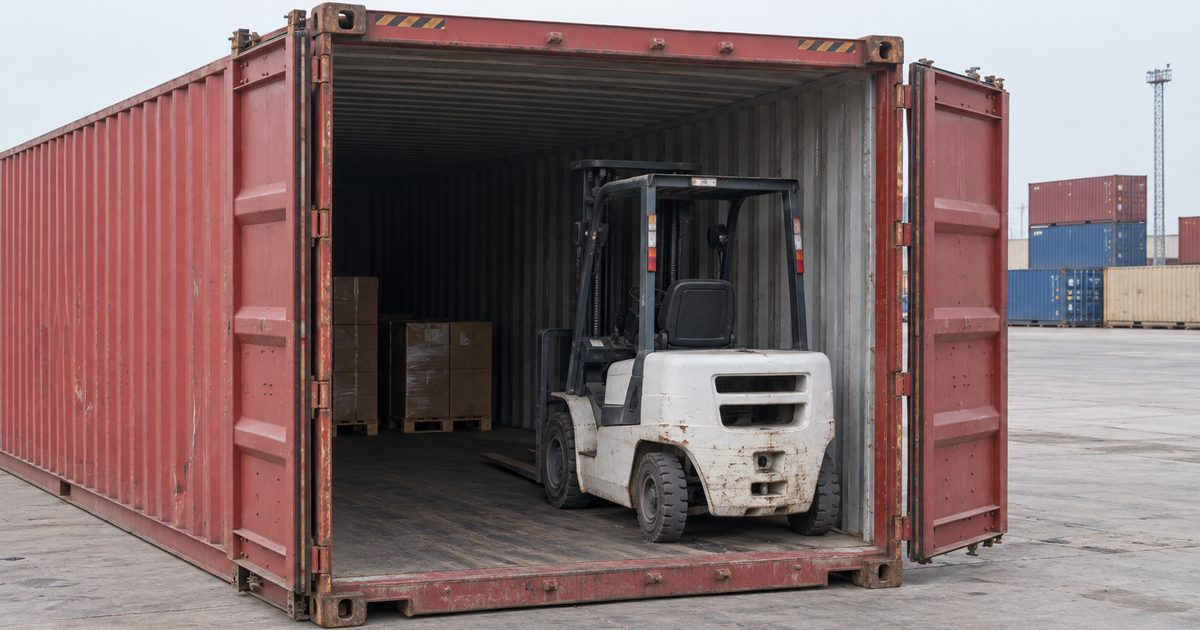
If the machine can be made to fit in a box, it ships in a box. A counterbalance forklift up to about five tonnes goes inside a 20ft or 40ft dry container, because containers sail more often and reach far more ports, and the machine stays locked away from weather and hands. Roll-on roll-off is for machines that cannot be made to fit.
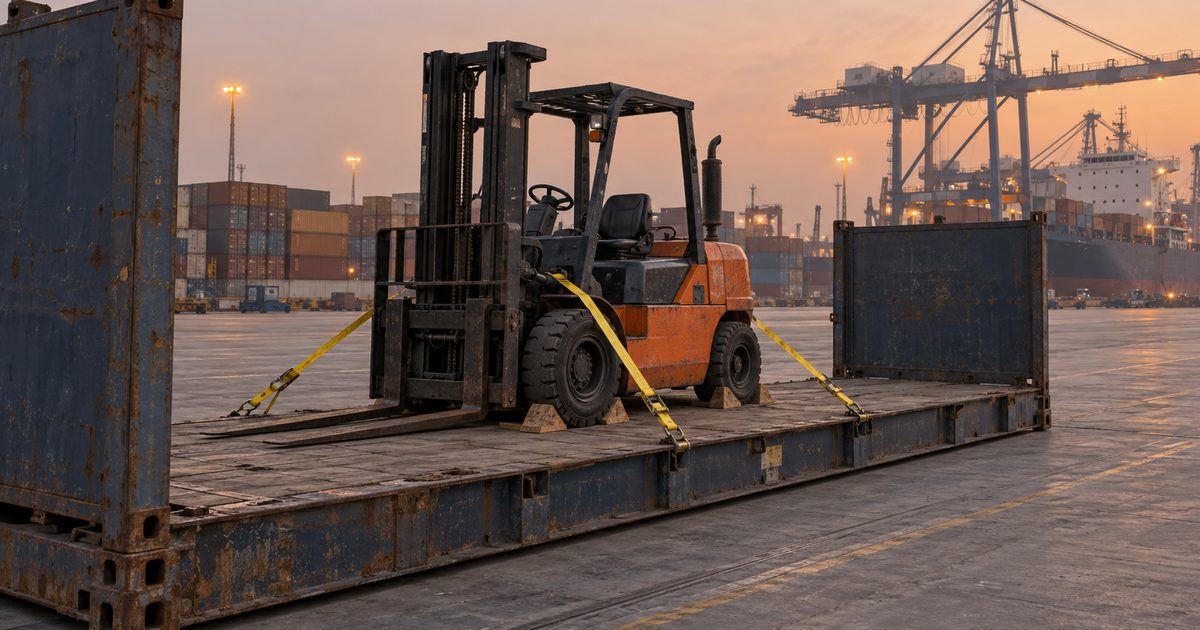
On a roll-on roll-off ship the machine is driven aboard on its own wheels and lashed to the deck, and nothing gets dismantled. The catch is how the space is sold. RoRo is measured in lane metres, the deck area your machine occupies, so you pay for floor rather than for a box. That works for a reach stacker, and works badly for an ordinary 2.5 tonne forklift on fewer sailings to fewer ports.
The container route is lift-on lift-off. The machine is driven or winched in, then blocked and lashed to the floor. A flat rack or open top container takes a machine too tall for a dry box, and breakbulk means it is lifted aboard as one piece above about ten tonnes. What each route costs is a separate question, covered in our guide to what it costs to ship a forklift worldwide.
Will it fit? Forklift dimensions versus 20ft and 40ft internals
The door, not the box, is what catches people out. A standard dry container is roughly 2,390 mm tall inside, but the door opening is only about 2,280 mm high and 2,340 mm wide. If the machine is taller than the door frame with the mast fully lowered, it does not go in, however much headroom sits beyond the frame.
| Container | Internal length | Internal width | Internal height | Door opening, W x H | Tare, typical | Payload, typical |
|---|
| 20ft standard dry | 5,898 mm | 2,352 mm | about 2,390 mm | 2,340 x 2,280 mm | 2,200 to 2,300 kg | about 27,800 to 28,200 kg |
| 40ft standard dry | 12,032 mm | 2,352 mm | about 2,390 mm | 2,340 x 2,280 mm | 3,750 to 4,000 kg | about 26,500 to 26,700 kg |
| 40ft high cube | 12,032 mm | 2,352 mm | 2,698 mm | 2,340 x 2,585 mm | 3,900 to 4,000 kg | about 26,500 kg |
Those are typical ISO figures. Containers vary by builder and by build year, and while the plated maximum gross is commonly 30,480 kg, some 40ft units are plated higher. The CSC plate on the door is the authority, exactly as the data plate is on a forklift. Now the machine, by capacity band.
| Rated capacity | Length, forks removed | Length, forks fitted | Overall width | Height over the guard | Service weight |
|---|
| 1.3 to 1.5 tonnes | about 2.30 m | about 3.35 m | about 1.07 m | about 2.15 m | about 2.5 to 3.0 t |
| 2.0 to 2.5 tonnes | about 2.60 to 2.65 m | about 3.70 m | about 1.15 m | about 2.15 m | about 3.6 to 4.0 t |
| 2.5 to 3.0 tonnes | about 2.80 m | about 3.85 m | about 1.24 m | about 2.17 m | about 4.2 to 4.6 t |
| 4.5 to 5.0 tonnes | about 3.30 m | about 4.50 m | about 1.45 m | about 2.22 m | about 7.0 to 7.5 t |
Every figure moves with the mast, the tyres and any attachment, so the spec sheet and the data plate settle it. Notice how close the guard runs to the door. A machine at 2.15 m clears a 2.28 m door by around 130 mm, and a taller mast swallows that.
Get these six things from whoever is standing next to the machine, photographed with a tape measure in the shot.
- Width at the widest point. Usually across the drive tyres or the counterweight, not the mast.
- Length from the counterweight to the fork face, then again with the forks off, and whether they lift off or are pinned.
- Height over the overhead guard, and separately over the mast fully lowered. The guard is usually the tallest point.
- Tyre type. Pneumatic or solid changes the machine height, so it changes whether it clears the door.
- Any attachment on the carriage. A side shift or fork positioner adds length ahead of the carriage.
- The data plate, for the model, the serial and the service weight.
If the machine will also work inside containers, see container spec forklifts, mast height and free lift.
How many forklifts fit in a 20ft and a 40ft container
With the forks removed and the masts fully lowered, a 20ft container takes two counterbalance forklifts up to about three tonnes, or one machine of five tonnes. A 40ft takes four of the smaller trucks or three five tonne machines. Leave the forks fitted and those counts fall to one in a 20ft, and to three in a 40ft for the smaller trucks and two for the five tonne machines, because a pair of forks adds more than a metre to every machine in the box.
| Rated capacity | 20ft, forks fitted | 20ft, forks removed | 40ft, forks fitted | 40ft, forks removed | Cargo weight, full 40ft |
|---|
| 1.3 to 1.5 tonnes | 1 | 2 | 3 | 5 | about 13 to 15 t |
| 2.0 to 2.5 tonnes | 1 | 2 | 3 | 4 | about 15 to 16 t |
| 2.5 to 3.0 tonnes | 1 | 2, tight | 3, tight | 4 | about 17 to 18 t |
| 4.5 to 5.0 tonnes | 1 | 1 | 2 | 3 | about 21 to 23 t |
Check every count yourself. Divide the container's internal length by the machine length. Four 2.5 tonne trucks with the forks off use about 10,600 mm of a 40ft's 12,032 mm. Five would need about 13,250 mm, so five does not go.
Two warnings sit on that arithmetic. These are counts by length alone, and a loading gang also needs room to drive each machine in, get the operator out and swing a ratchet at every tie down point. The machines go nose to tail, never side by side, because two trucks at 1,150 mm wide come to 2,300 mm inside a 2,352 mm box.
Straight answer. For the machine most buyers are actually moving, a 2.5 tonne diesel counterbalance, the honest count is one in a 20ft with the forks on, two in a 20ft with the forks off, and four in a 40ft with the forks off. If somebody quotes you more than four in a 40ft, ask which machine length they used.
Weight or length: which one runs out first?
For machines up to about three and a half tonnes of capacity, length runs out long before weight. Four 2.5 tonne trucks in a 40ft come to roughly 15 tonnes of cargo against a payload of about 26 tonnes, so the floor is full while the container is barely half loaded. Above five tonnes that flips, and at your end it is usually the road limit, not the container's plate, that decides.
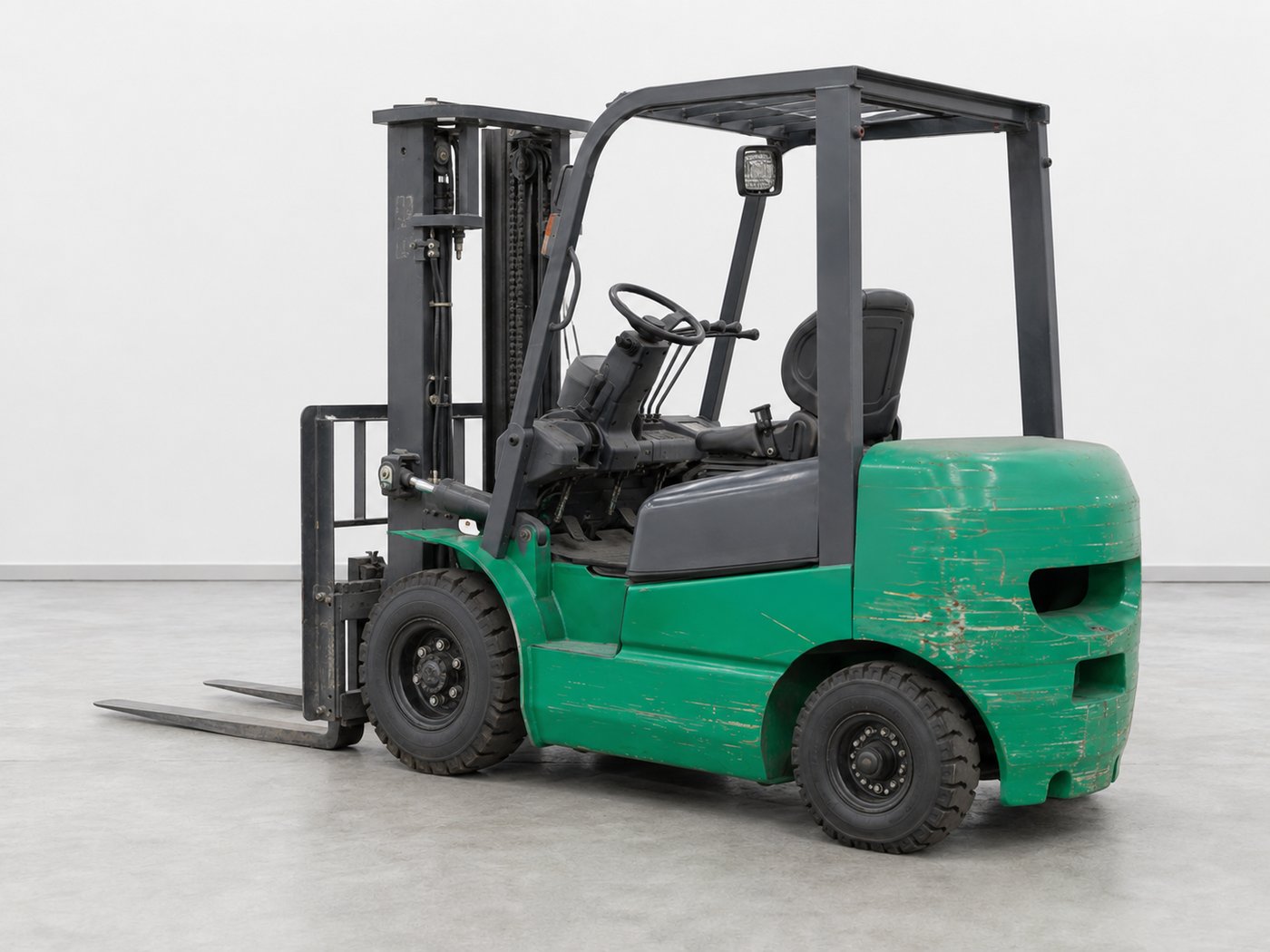
A counterbalance forklift weighs far more than it lifts. Across published manufacturer figures its service weight runs at roughly one and a half to twice the rated capacity, so a 2.5 tonne truck is close to four tonnes empty and a five tonne truck around seven. Work from the service weight on the data plate, never from the capacity.
Since 1 July 2016, under an amendment to the SOLAS convention, a packed container cannot be loaded onto a ship unless its verified gross mass has been declared, and the International Maritime Organization is clear that the shipper carries that responsibility. Verified gross mass is the container tare plus everything inside it, blocking timber included.
The last limit waits at your port. A 40ft with three five tonne machines is around 21 to 23 tonnes of cargo before you add roughly four tonnes of container, and plenty of countries cap what one trailer may carry on the road well below what the box is plated for. Ask your clearing agent for the road limit first.
Preparing the machine: fluids, battery, mast, cleaning and quarantine
A machine is not ready to load until the fuel is run down, the battery is disconnected and the terminals insulated, the mast fully lowered, the forks off or lashed flat, and the truck washed clean of soil. Skip the wash and you can lose weeks at the far end to a quarantine inspection.
Fuel and batteries are where you ask rather than assume. An internal combustion engine with fuel in it is treated as dangerous goods under the IMDG Code unless the shipping line's conditions are met, and every line words those conditions differently. In practice they want the tank run down, the battery disconnected with the terminals taped, and the machine declared. An LPG truck normally travels with the cylinder removed.
Straight answer. We do not print one fuel and battery rule here, because there is not one to print. It is set by the shipping line under the IMDG Code and changes by line, by trade lane and by whether the machine is diesel, LPG or lithium. Get the line's written conditions before the machine is booked.
Cleaning is not cosmetic. Several countries inspect used machinery at the border for soil, seeds, plant material and insects, and Australia and New Zealand are the two importers talk about most. Inspectors look in the mast channels, under the counterweight, in the tyre treads, in the radiator fins and along the underside. A dirty machine means cleaning or fumigation at the port, so check the destination's import standard before loading.
The mast comes down fully and stays down. On a tall mast machine it is sometimes unbolted and laid on the container floor beside the truck, which is ordinary practice and worth agreeing in advance, because somebody at your end has to refit it. Loose forks get lashed like any other cargo.
Photograph all of it before the doors close. Machine clean, mast down, forks stowed, hour meter, data plate, the machine chocked and lashed, and the container seal number. That is the only evidence anyone holds in a dispute, the same logic that applies when buying a forklift from overseas.
Lashing and blocking: how a forklift is actually secured
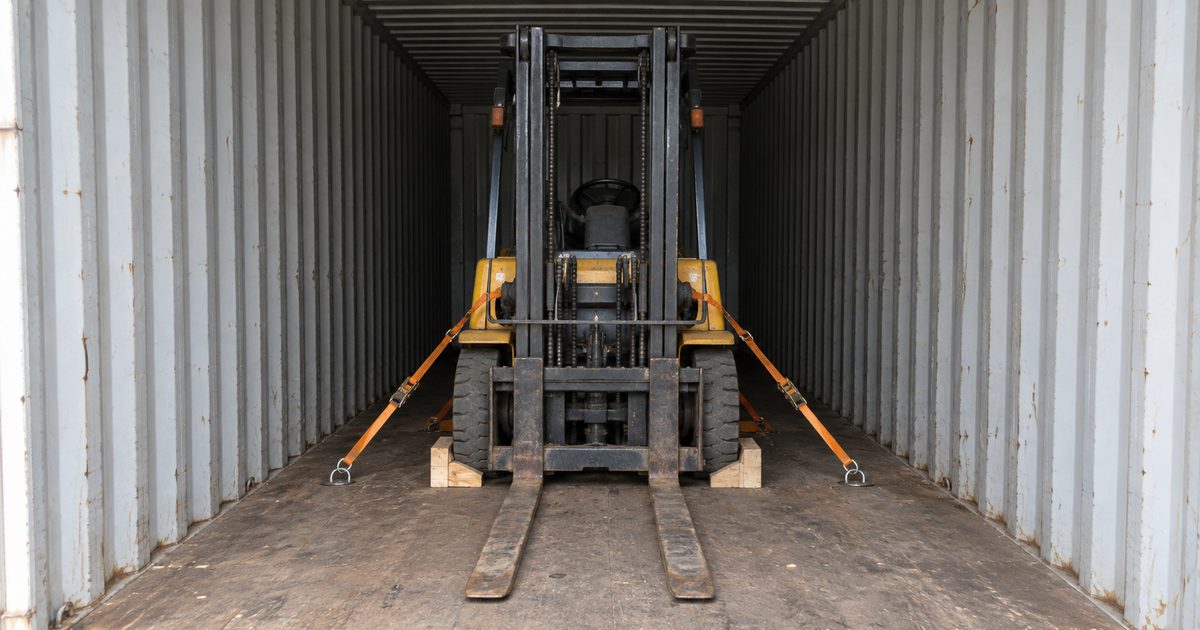
A forklift is secured to the container floor, not to the walls. The wheels are chocked front and back with timber fixed to the floor, and the machine is lashed through its own tie down points to the container's lashing rings, at a shallow angle so it is held down as well as back.
The reference everyone works from is the CTU Code, which the International Maritime Organization describes as a non-mandatory global code of practice for the handling and packing of cargo transport units, developed jointly with the International Labour Organization and the UN Economic Commission for Europe. It is not law, but it is what a surveyor measures your packing against.
What good practice looks like on a forklift:
- Parked square and central, wheels straight, parking brake on, transmission in neutral, key out.
- Nothing touching the walls, the roof or the doors, with a clear gap all round.
- Every wheel chocked fore and aft with timber nailed to the floor, not wedged under the tyre.
- Lashings on the machine's own tie down points, marked on the frame and shown in the operator manual. Never on the mast, the guard or anything hydraulic.
- Lashings run to the floor level rings at a shallow angle, commonly 30 to 45 degrees, so the force pulls the machine down as well as back.
- Enough lashings that no single one is carrying the machine. Each ring has a rated capacity set by the container owner.
- Every piece of blocking, bracing or dunnage timber carrying the ISPM 15 mark.
That last line is the trap. ISPM 15 is the International Plant Protection Convention standard for wood packaging over 6 mm thick, and it explicitly covers dunnage, the timber used to secure cargo. The wood must be debarked and treated, by heat to 56 degrees Celsius for at least 30 minutes or by fumigation, then stamped with the IPPC mark. Untreated blocking timber can hold the whole container.
The papers that travel with the machine
A forklift crossing a border needs a commercial invoice, a packing list, a bill of lading and usually a certificate of origin. Everything beyond that depends on where it is going, and the items that catch people out are the ones that must be issued before the machine sails.
- Commercial invoice. The machine described properly, with make, model, serial number, year, condition and value.
- Packing list. Everything inside the container, including removed forks, spare mast sections and parts sent loose.
- Bill of lading or sea waybill. The contract of carriage, and with an original bill it also releases the cargo. Agree whether you get an original set or a telex release.
- Certificate of origin. Often what decides whether you pay a standard duty rate or a preferential one.
- Verified gross mass declaration. Submitted by the shipper before the box is loaded.
- Marine insurance certificate. Insure the machine, not only the freight.
Then comes the local layer. A number of countries require a conformity or pre-shipment inspection certificate issued in the country of export, and it cannot be produced once the vessel has sailed. Some cap the age of used machinery they will admit. Both are decided by the destination, so ask your customs broker before you pay a deposit.
Keep the serial number identical on every document and matching the plate on the machine. If the invoice, the bill of lading and the data plate disagree, the shipment sits at the port while corrected paperwork is issued, and you pay storage while it does.
When we source a machine we work to these same numbers before anything is booked, and we put the loading and lashing plan in writing. Tell us the machine and the port, or see what we source and ship.
Frequently asked questions
How many forklifts fit in a 40ft container?
Four counterbalance trucks up to about three tonnes, with the forks removed and the masts fully lowered, or three machines of five tonnes. With the forks left on it drops to three of the smaller machines or two of the five tonne ones. Length is what limits it, not weight, because a 40ft gives you 12,032 mm of floor and four 2.5 tonne trucks with the forks off use about 10,600 mm of it.
Can you fit a forklift in a 20ft container?
Yes. One machine goes in with the forks still fitted. Two counterbalance trucks up to about three tonnes fit with the forks removed and the masts lowered. The two numbers that decide it are the door opening, about 2,280 mm high and 2,340 mm wide, and the 5,898 mm of internal floor length.
How much does a forklift weigh for shipping?
Roughly one and a half to twice its rated capacity, so a 2.5 tonne machine is usually close to four tonnes empty and a five tonne machine sits around seven. Use the service weight printed on the data plate rather than the capacity, because the shipper has to declare a verified gross mass before the container can be loaded.
Is container or RoRo better for shipping a forklift?
For a standard counterbalance truck that can be made to fit inside a box, container is normally the better answer, because containers sail more often and reach far more ports and the machine stays enclosed. RoRo earns its place when the machine is too tall or too heavy to be driven in and blocked inside a container. We quote both when there is a real choice.
Do the forks have to come off to ship a forklift in a container?
Not always, but taking them off frees more than a metre of floor per machine, and that is often what turns three machines in a 40ft into four. Removed forks must be laid flat and lashed down like any other cargo, never left loose on the floor.
Does a forklift need to be cleaned before it is shipped?
Yes. Several countries inspect used machinery at the border for soil, seeds, plant material and insects, and a dirty machine means cleaning or fumigation at your cost plus a delay. Wash the mast channels, tyre treads, radiator fins and the underside before loading, then photograph it clean.

Written by The Forklifter team. We sell used and new forklifts across Pakistan and for export, and we rent across Pakistan. The advice here is the same we give buyers on WhatsApp before they spend a rupee or a dollar.